 RSS Feed (xml)
Peter J. Sartain, former Bishop of Little Rock was installed as Bishop of Joliet yesterday. Bishop Sartain will definately be missed in the Diocese of Little Rock.
Gerald has an interview with Bishop Sartian over at the Cafeteria is Closed.
Wednesday, June 28, 2006


Tuesday, June 27, 2006
Your letter has been received and filed appropriately.......trash
From RCFM by way of LifeSiteNews.com
But, I really want to address the fact that these "religious leaders" including thier "Roman Catholic" liaisons don't know diddly about the Catholic Church. This letter continually talks of the teachings of the Roman Catholic Church and the Roman Catholic magesterium. There is no "Roman Catholic Church". There is the one Catholic Church made up of several rites one of which (and the largest) happens to be the Roman or more appropriately Latin rite. There are over twenty rites, in 4 major groupings, in communion with the Bishop of Rome.
Read about the rites in communion with Rome at EWTN
Open Letter to Cardinal O’Malley and the Roman Catholic Bishops of MassachusettsFirst of all. The right to marry comes from God, who established it for one man and one woman. As far as taking away any civil rights....in the overwhelming majority of states (all but Massachusetts) this civil right doesn't exist and therfore can't be "taken away".
As ministers, rabbis and religious leaders of many faith traditions, we urge you to stop your political campaign to take away civil marriage rights from gay and lesbian citizens. At a time when the Roman Catholic Church says it is trying to promote tolerance and diversity it is lobbying the legislature and campaigning publicly to ban same-sex marriage in the Commonwealth.
The Roman Catholic magisterium teaches that homosexuality and gay unions are gravely immoral (not exactly correct, read CCC 2357-2359). We disagree with that doctrine (the esscence of protestantism and cafeteria catholicism . . . wait protestantism is sufficient), and we rejoice and celebrate marriage equality in Massachusetts. However, we honor your right to believe as you wish. We respect your right to practice your faith according to your laws.
We ask that you respect our faith traditions in return. Taking away civil marriage rights from committed, loving gay and lesbian couples would deny us the right to practice our beliefs. (so you want the Church to back off of promoting its position to society so that you can force yours on society through activist judges and radical politicians?) We would no longer be able to marry same-sex couples legally. The state would be in the position of granting full rights and protections to everyone married according to your beliefs, while denying those rights and protections to couples married according to ours.
You are promoting prejudice through your political campaign, intentionally or not.
By proclaiming homosexuality and same-sex unions to be universally immoral and worthy of second-class status under state law, you are sending a message that our faith communities are immoral. You are harming us and our families and your own faithful as well. Thousands of Roman Catholics have signed our Roman Catholic Statement in support of marriage equality. They have signed out of their pain and their love and concern for the Church. (You know you can't say that with a straight face!)
We all have a right to speak our minds and to vote according to our beliefs, but in the political realm, we also have a constitutional responsibility to protect minorities, including the gay, lesbian, transgender and bisexual individuals and our minority religious communities. Our founding fathers understood the importance of protecting minorities and of preventing sectarian beliefs from becoming civil laws.
Worldwide, we can witness the unfortunate consequences when religious groups try to use government power to impose their will on multi-cultural societies.(and what are you doing? Homosexual marriage is not the norm, you are trying to force it on society.) Respecting and protecting the dignity of every soul, regardless of sexual orientation or religious beliefs, is the American way -- and the only way to protect the religious freedom and the democratic society we all cherish.
We urge you to stop trying to make your religious definition of marriage and family the law of our Commonwealth. Please stop trying to put personal faith up for a popular vote in 2008. Let’s return our focus to our common mission of promoting a socially just and tolerant society.
Faithfully,
The Religious Coalition for the Freedom to Marry Board:
The Rev’d. Anne C. Fowler, President
Rabbi Howard Berman
Rabbi Devon A. Lerner, Executive Director
Rev. Quinn Caldwell
The Rev’d. George C. Welles, Jr.
Rev. Tiffany Steinwert
Rev. David Pettee
Rabbi Daniel Judson
Charles Martel, Roman Catholic Liaison
Rev. Irving Cummings
Constance Cervone, Roman Catholic Liaison
Rev. Maureen Reddington-Wilde
But, I really want to address the fact that these "religious leaders" including thier "Roman Catholic" liaisons don't know diddly about the Catholic Church. This letter continually talks of the teachings of the Roman Catholic Church and the Roman Catholic magesterium. There is no "Roman Catholic Church". There is the one Catholic Church made up of several rites one of which (and the largest) happens to be the Roman or more appropriately Latin rite. There are over twenty rites, in 4 major groupings, in communion with the Bishop of Rome.
Read about the rites in communion with Rome at EWTN
Monday, June 26, 2006
Pope on music at Mass
In relation to my earlier post about Liturgical Music:
VATICAN: POPE AGAINST POP MUSIC DURING MASS
VATICAN: POPE AGAINST POP MUSIC DURING MASS
VATICAN: POPE AGAINST POP MUSIC DURING MASS Vatican City, 26 June (AKI) - Pope Benedict XVI has called for traditional sacred music to be played during mass, condemning the ongoing custom of contemporary music at religious celebrations. "Updating sacred music is possible, but this cannot happen unless it follows the tradition of Gregorian chants or sacred polyphony," the pontiff said on Sunday on the sidelines of a concert in the Sistine Chapel. A skilled pianist with a predilection for Bach and Mozart, Benedict XVI spoke against a custom reportedly appreciated by his more informal predecessor John Paul II, who worked very hard throughout his papacy to make the Church more appealing to the younger generations.Hat tip: Gerald at The Cafeteria is Closed
In an interview published in Turin-daily La Stampa on Monday, the former Archbishop of Ravenna, veteran Cardinal Ersilio Tonini also condemned the practice saying that "Benedict XVI is right, mass is a meeting with God and to meet God sacred music is better than the turmoil of electric guitars, hand clapping and the husstle and bustle of disorderly sounds."
Tonini said that 40 years ago after the Second Vatican Council "making mass more popular and inviting could be understood." However, the cardinal added, "we exaggerated and now I believe it is legitimate to consider as over this season of breaks with tradition."
Sunday, June 25, 2006
Liturgical Music or "Let's Pat Ourselves on the Back in Song"
I can't help but notice how much of the music is focused on, "I'm so good, look at what I've done" or "Look at what Jesus did for us because we are such wonderful people"
It's amazing how often the words I, my, me, we, us, our, and you pop up in the "hymns" we sing at Mass. What is more disturbing is the hymns that don't make any reference to God or Christ at all. We are there to worship Him, not to pat ourselves on the back. Don't get me wrong, I don't think we should be self-loathing or anything. But when we are at Mass, before the Alter of God, our focus should be on worshiping him not telling each other how wonderful we are.
It's amazing how often the words I, my, me, we, us, our, and you pop up in the "hymns" we sing at Mass. What is more disturbing is the hymns that don't make any reference to God or Christ at all. We are there to worship Him, not to pat ourselves on the back. Don't get me wrong, I don't think we should be self-loathing or anything. But when we are at Mass, before the Alter of God, our focus should be on worshiping him not telling each other how wonderful we are.
Articulation of the Faith
I have this standing debate with a friend about Apostolic succession and the Church's guardianship of the Truth and how that Truth has been passed down. I think some of what Cardinal Arinze says in God's Invisible Hand sheds some light onto this subject. Please bear with me as I quote at length with emphasis added.
Without this central authority in the Church to hold and articulate the Truth we get exactly what Cardinal Arinze is speaking about when he says, "The articulation of the faith retains its imporantce, otherwise we will soon become a type of spiritiual group in which nobody knows what he believes, nobody can articulate it, nobody knows what to hand down, and nobody can say to anyone, 'You are not believing what our ancestors in the faith handed down to us.' " The Protestant churches today, and thier many disagreements in belief and doctrine, provide a perfect example of what happens when the teaching authority of the Church, established by Christ and given to the apostles, is rejected.
O'Connell: We say we have the fullness of revelations, and yet at the end of time we know that there will be a full revelation in a way that we had never imagined.So to address a point raised recently, the Church is the guardian of the Truth revealed to us through Jesus Christ. But as humans, none of us posses the capability of completely understanding the Truth. We grow in our understanding through time. Likewise the Church, as a human institution, could not be expected to fully understand the Truth immediately. Trough time the Church gains a deeper understanding and knowledge of the Truth, with it then articulates as part of its duty. The Church doesn't make the Truth, it holds and articulates the Truth.
Cardinal Arinze: When we say we have the fullness of revelation, we must go carefully. The fullness of revelation has been given to manking in Jesus Christ, and he has entrusted this to his Church. But that does not mean that every one of us in the Church knows God fully. We would not be so proud. We only know a little. We can grow.
It does not even mean that the Church as a whole does not grow. The Church grows in that knowledge of God, and in the knowledge of revelation, and as the ages role by, the Church -- by prayer, by reflection, by reading the lives of the saints and the early teachers or Fathers of the Church, and by the assistance of the Holy Spirit--comes to a better understanding of some parts of our Faith. So the whole Church grows; much more do individuals grow.
O'Connell: Thos who will read this will say your words speak to thier own experience, more so than documents that seem to affirm with great certainty adn clarity but, at times, do not reach the hearts of people.
Cardinal Arinze: To say that one individual can be nearer to God than another does not mean that the Church should abandon her duty to articulate the faith. We notice that from the early years of the Church, from the second, third, and fourth centuries, the bishops, coming together with the Pope or his delegate, felt it their duty to say, "This is what we believe, we believe, we believe." That is the origin of the Credo.
It is the duty of the teaching authority of the Church to articulate that faith, that is, to state it in human language, also using philosopical terms or concepts, because the faith has to be handed down. If we handed down the fiath only by silent witness, but not by a simple word, you would soon find that the child growing up does not know in what faith he is being initiated. That's why the credos were often tied to baptism. The person is being baptized into the faith of that community as articulated. The articulation of the faith retains its imporantce, otherwise we will soon become a type of spiritiual group in which nobody knows what he believes, nobody can articulate it, nobody knows what to hand down, and nobody can say to anyone, "You are not believing what our ancestors in the faith handed down to us."
Because in the days of the aposles, Saint Peter and Saint Paul, we are told that Saint Peter said, "There are several things Paul wrote that are difficult to understand and that some abuse to their own destruction." Saint Paul was very strict on what people were to believe. He told the Galatians, "If anyone preaces a Gospel to you different from the one we have preached to you, let him be anathema. So you are to believe what has been handed down to you, and not to believe anythign else." This means that they were also very careful about the articulation of the faith even in the days of Saint Paul.
How much more so, later one, when the Church had met Greek and Roman philosophy, and the faith had to be expressed in those terms. How much more so also when some began to say there are two persons in Christ, so the Church was compelled to express herself on this quesion; or again when people said Christ was not God, the the Councils of Nicaea and Constantinople had to say no: "He is God from God, Light from Light, true God from true God, begotten not made, one in substance with the Father, and through him all things were made." All that articulation came with time.
Without this central authority in the Church to hold and articulate the Truth we get exactly what Cardinal Arinze is speaking about when he says, "The articulation of the faith retains its imporantce, otherwise we will soon become a type of spiritiual group in which nobody knows what he believes, nobody can articulate it, nobody knows what to hand down, and nobody can say to anyone, 'You are not believing what our ancestors in the faith handed down to us.' " The Protestant churches today, and thier many disagreements in belief and doctrine, provide a perfect example of what happens when the teaching authority of the Church, established by Christ and given to the apostles, is rejected.
Saturday, June 24, 2006
Douay-Rheims Bible Online
I found this great resource lately. Searchable Douay-Rheims Bible and if you are into Latin Latin Vulgate. I'm adding it to the sidebar.
Friday, June 23, 2006
Solemnity of the Nativity of Saint John the Baptist
 Luke 1:5-20, 36-44, 57-80
5 There was in the days of Herod, the king of Judea, a certain priest named Zachary, of the courese of Abia; and his wife was of the daughters of Aaron, and her name Elizabeth.
6 And they were both just before God, walking in all the commandments and justifications of the Lord without blame. 7 And they had no son, for that Elizabeth was barren, and they both were well advanced in years. 8 And it came to pass, when he executed the priestly function in the order of his course before God, 9 According to the custom of the priestly office, it was his lot to offer incense, going into the temple of the Lord. 10 And all the multitude of the people was praying without, at the hour of incense.
11 And there appeared to him an angel of the Lord, standing on the right side of the alter of incense. 12 And Zachary seeing him, was troubled, and fear fell upon him. 13 But the angel said to him: Fear not, Zachary, for thy prayer is heard; and thy wife Elizabeth shall bear thee a son, and thou shalt call his name John: 14 And thou shalt have joy and gladness, and many shall rejoice in his nativity. 15 For he shall be great before the Lord; and shall drink no wine nor strong drink: and he shall be filled with the Holy Ghost, even from his mother's womb.
16 And he shall convert many of the children of Israel to the Lord their God. 17 And he shall go before him in the spirit and power of Elias; that he may turn the hearts of the fathers unto the children, and the incredulous to the wisdom of the just, to prepare unto the Lord a perfect people. 18 And Zachary said to the angel: Whereby shall I know this? for I am an old man, and my wife is advanced in years. 19 And the angel answering, said to him: I am Gabriel, who stand before God: and am sent to speak to thee, and to bring thee these good tidings. 20 And behold, thou shalt be dumb, and shalt not be able to speak until the day wherein these things shall come to pass, because thou hast not believed my words, which shall be fulfilled in their time.
36 And behold thy cousin Elizabeth, she also hath conceived a son in her old age; and this is the sixth month with her that is called barren: 37 Because no word shall be impossible with God. 38 And Mary said: Behold the handmaid of the Lord; be it done to me according to thy word. And the angel departed from her. 39 And Mary rising up in those days, went into the hill country with haste into a city of Juda. 40 And she entered into the house of Zachary, and saluted Elizabeth.
41 And it came to pass, that when Elizabeth heard the salutation of Mary, the infant leaped in her womb. And Elizabeth was filled with the Holy Ghost: 42 And she cried out with a loud voice, and said: Blessed art thou among women, and blessed is the fruit of thy womb. 43 And whence is this to me, that the mother of my Lord should come to me? 44 For behold as soon as the voice of thy salutation sounded in my ears, the infant in my womb leaped for joy.57 Now Elizabeth's full time of being delivered was come, and she brought forth a son. 58 And her neighbours and kinsfolks heard that the Lord had shewed his great mercy towards her, and they congratulated with her. 59 And it came to pass, that on the eighth day they came to circumcise the child, and they called him by his father's name Zachary. 60 And his mother answering, said: Not so; but he shall be called John.
61 And they said to her: There is none of thy kindred that is called by this name. 62 And they made signs to his father, how he would have him called. 63 And demanding a writing table, he wrote, saying: John is his name. And they all wondered. 64 And immediately his mouth was opened, and his tongue loosed, and he spoke, blessing God. 65 And fear came upon all their neighbours; and all these things were noised abroad over all the hill country of Judea.
66 And all they that had heard them laid them up in their heart, saying: What an one, think ye, shall this child be? For the hand of the Lord was with him. 67 And Zachary his father was filled with the Holy Ghost; and he prophesied, saying: 68 Blessed be the Lord God of Israel; because he hath visited and wrought the redemption of his people: 69 And hath raised up an horn of salvation to us, in the house of David his servant: 70 As he spoke by the mouth of his holy prophets, who are from the beginning:
71 Salvation from our enemies, and from the hand of all that hate us: 72 To perform mercy to our fathers, and to remember his holy testament, 73 The oath, which he swore to Abraham our father, that he would grant to us, 74 That being delivered from the hand of our enemies, we may serve him without fear, 75 In holiness and justice before him, all our days.
76 And thou, child, shalt be called the prophet of the Highest: for thou shalt go before the face of the Lord to prepare his ways: 77 To give knowledge of salvation to his people, unto the remission of their sins: 78 Through the bowels of the mercy of our God, in which the Orient from on high hath visited us: 79 To enlighten them that sit in darkness, and in the shadow of death: to direct our feet into the way of peace. 80 And the child grew, and was strengthened in spirit; and was in the deserts until the day of his manifestation to Israel.
God's Invisible Hand
I am currently reading God's Invisible Hand: The Life and Work of Francis Cardinal Arinze. Gerald O'Connell presents the transcripts of several interviews he conducted with Cardinal Arinze over four years. The content of the interviews is arranged in chronological order from 1932 to 2002. I'm about halfway through it and already I'm confident in recommending it as a worthy read.
As I read what Cardinal Arinze has to say about "God's Invisible Hand" I can't help but think about the workings of God's hand in my own life. It's amazing to look back and see what events, as insignificant as they seemed at time, have shaped your journey through life.
For instance, I had no intentions of attending the University that I did. It was only a few months before classes started that a new teacher introduced me to the idea of attending this particular school. There I met someone who invited me to my first Mass at St. Joseph's. Over a few years I attended Mass sporadically at St. Joseph's until someone I worked with happened to see me at church one Sunday and invite me to the University parish, St. Thomas Aquinas. Soon after I was attending Mass every Sunday and two years later I'm Catholic!
Along the way there are several key people that had I never met I may not be where I am right now. You never know when the smallest event is going to have a big and long lasting impact.
As I read what Cardinal Arinze has to say about "God's Invisible Hand" I can't help but think about the workings of God's hand in my own life. It's amazing to look back and see what events, as insignificant as they seemed at time, have shaped your journey through life.
For instance, I had no intentions of attending the University that I did. It was only a few months before classes started that a new teacher introduced me to the idea of attending this particular school. There I met someone who invited me to my first Mass at St. Joseph's. Over a few years I attended Mass sporadically at St. Joseph's until someone I worked with happened to see me at church one Sunday and invite me to the University parish, St. Thomas Aquinas. Soon after I was attending Mass every Sunday and two years later I'm Catholic!
Along the way there are several key people that had I never met I may not be where I am right now. You never know when the smallest event is going to have a big and long lasting impact.
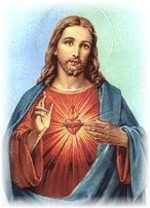 Litany of the Sacred Heart
Lord, have mercy
Christ, have mercy
Lord, have mercy
God our Father of Heaven, have mercy on us.
God the Son, Redeemer of the world, have mercy on us.
God the Holy Spirit, have mercy on us.
Holy Trinity, One God, have mercy on us.
Response: have mercy of us
Heart of Jesus, Son of the Eternal Father,
Heart of Jesus, formed by the Holy Spirit in the womb of the Virgin Mother,
Heart of Jesus, one with the eternal Word,
Heart of Jesus, Infinite in Majesty,
Heart of Jesus, holy Temple of God,
Heart of Jesus, Tabernacle of the Most High,
Heart of Jesus, House of God and Gate of Heaven,
Heart of Jesus, aflame with love for us,
Heart of Jesus, source of justice and love,
Heart of Jesus, full of goodness and love,
Heart of Jesus, well-spring of all virtue,
Heart of Jesus, most worthy of all praise,
Heart of Jesus, king and center of all hearts,
Heart of Jesus, treasure-house of wisdom and knowledge,
Heart of Jesus, in Whom there dwells the fullness of God,
Heart of Jesus, in Whom the Father is well pleased,
Heart of Jesus, from Whose fullness we have all received,
Heart of Jesus, desire of the eternal hills,
Heart of Jesus, patient and full of mercy,
Heart of Jesus, generous to all who turn to you,
Heart of Jesus, fountain of life and holiness,
Heart of Jesus, atonement for our sins,
Heart of Jesus, overwhelmed with insults,
Heart of Jesus, broken for our sins,
Heart of Jesus, obedient even to death,
Heart of Jesus, pierced by a lance,
Heart of Jesus, source of all consolation,
Heart of Jesus, our life and resurrection,
Heart of Jesus, our peace and reconciliation,
Heart of Jesus, victim of our sins,
Heart of Jesus, salvation of all who trust in you,
Heart of Jesus, hope of all who die in you,
Heart of Jesus, delight of all the Saints,
Lamb of God, Who takes away the sins of the world, have mercy on us.
Lamb of God, Who takes away the sins of the world, have mercy on us.
Lamb of God, Who takes away the sins of the world, have mercy on us.
V. Jesus, gentle and humble of heart.
R. Touch our hearts and make them like Your own.
Let us pray:
Father, we rejoice in the gifts of love we have received from the heart of Jesus Your Son. Open our hearts to share His life and continue to bless us with His love. We ask this in the name of Jesus the Lord.
Amen.
Source: Catholic Youth Networking
World Day of Prayer for Priests
John Paul II has established that on the solemnity of the Sacred Heart the Church will observe the World Day of prayer for the Sanctification of Priests.
Source: worldpriestday.com
Source: worldpriestday.com
St. Thérèse’s Prayer for Priests
‘O Holy Father, may the torrents of love flowing from the sacred wounds of Thy Divine Son bring forth priests like unto the beloved disciple John who stood at the foot of the Cross; priests: who as a pledge of Thine own most tender love will lovingly give Thy Divine Son to the souls of men.
May Thy priests be faithful guardians of Thy Church, as John was of Mary, whom he received into his house. Taught by this loving Mother who suffered so much on Calvary, may they display a mother’s care and thoughtfulness towards Thy children. May they teach souls to enter into close union with Thee through Mary who, as the Gate of Heaven, is specially the guardian of the treasures of Thy Divine Heart.
Give us priests who are on fire, and who are true children of Mary, priests who will give Jesus to souls with the same tenderness and care with which Mary carried the Little Child of Bethlehem.
Mother of sorrows and of love, out of compassion for Thy beloved Son, open in our hearts deep wells of love, so that we may console Him and give Him a generation of priests formed in thy school and having all the tender thoughtfulness of thine own spotless love.’Thursday, June 22, 2006
Luukas is not doing well
From his mom by way of Defenders of the Catholic Faith forum
The doctors don't know how long he will live. He is not conscious and in a couple of months strong epilepsy might come as an addition to the whole situation. Within time things will only get worse. He is more likely to get infections and they are not going to treat them not to make him suffer longer. How will we live? We want to have more children, go to church and other places...'Things aren't looking good for Baby Luukas. However, God does work miracles and we should never give up on the power of prayer. This family is going through an unimaginably difficult time right now. Please pray for Luukas' family that they find comfort in the love of Christ and understanding in the acceptance of His will.
Optional Memorial
 St. Paulinus, Bishop of Nola: Born at Bordeaux about 354; died 22 June, 431. He sprang from a distinguished family of Aquitania and his education was entrusted to the poet Ausonius. He became governor of the Province of Campania, but he soon realized that he could not find in public life the happiness he sought. From 380 to 390 he lived almost entirely in his native land. He married a Spanish lady, a Christian named Therasia. To her, to Bishop Delphinus of Bordeaux and his successor the Presbyter Amandus, and to St. Martin of Tours, who had cured him of some disease of the eye, he owed his conversion. He and his brother were baptized at the same time by Delphinus. When Paulinus lost his only child eight days after birth, and when he was threatened with the charge of having murdered his brother, he and his wife decided to withdraw from the world, and to enter the monastic life. They went to Spain about 390. More from the Catholic Encyclopedia on New Advent
 St. John Fisher: Cardinal, Bishop of Rochester, and martyr; born at Beverley, Yorkshire, England, 1459 (?1469); died 22 June, 1535. John was the eldest son of Robert Fisher, merchant of Beverley, and Agnes his wife. His early education was probably received in the school attached to the collegiate church in his native town, whence in 1484 he removed to Michaelhouse, Cambridge. He took the degree of B.A. in 1487, proceeded M.A. in 1491, in which year he was elected a fellow of his college, and was made Vicar of Northallerton, Yorkshire. In 1494 he resigned his benefice to become proctor of his university, and three years later was appointed Master of Michaelhouse, about which date he became chaplain and confessor to Margaret Beaufort, Countess of Richmond and Derby, mother of King Henry VII. In 1501 he received the degree of D.D., and was elected Vice-Chancellor of Cambridge University. Under Fisher's guidance, the Lady Margaret founded St. John's and Christ's Colleges at Cambridge, and also the two "Lady Margaret" professorships of divinity at Oxford and Cambridge respectively, Fisher himself being the first occupant of the Cambridge chair. More from the Catholic Encyclopedia on New Advent
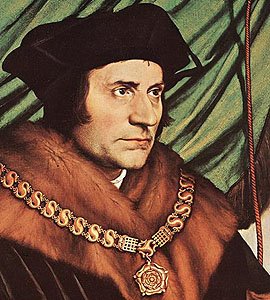 St. Thomas More: He was the sole surviving son of Sir John More, barrister and later judge, by his first wife Agnes, daughter of Thomas Graunger. While still a child Thomas was sent to St. Anthony's School in Threadneedle Street, kept by Nicholas Holt, and when thirteen years old was placed in the household of Cardinal Morton, Archbishop of Canterbury, and Lord Chancellor. Here his merry character and brilliant intellect attracted the notice of the archbishop, who sent him to Oxford, where he entered at Canterbury Hall (subsequently absorbed by Christ Church) about 1492. His father made him an allowance barely sufficient to supply the necessaries of life and, in consequence, he had no opportunity to indulge in "vain or hurtful amusements" to the detriment of his studies. At Oxford he made friends with William Grocyn and Thomas Linacre, the latter becoming his first instructor in Greek. Without ever becoming an exact scholar he mastered Greek "by an instinct of genius" as witnessed by Pace (De fructu qui ex doctrina percipitur, 1517), who adds "his eloquence is incomparable and twofold, for he speaks with the same facility in Latin as in his own language". Besides the classics he studied French, history, and mathematics, and also learned to play the flute and the viol. After two years' residence at Oxford, More was recalled to London and entered as a law student at New Inn about 1494. In February, 1496, he was admitted to Lincoln's Inn as a student, and in due course was called to the outer bar and subsequently made a bencher. His great abilities now began to attract attention and the governors of Lincoln's Inn appointed him "reader" or lecturer on law at Furnival's Inn, his lectures being esteemed so highly that the appointment was renewed for three successive years. More from the Catholic Encyclopedia on New Advent
I think it is worthwhile to note that Saints John Fisher and Thomas More both defied Henry VIII as Supreme Head of the Church in England, remaining loyal to the Church in Rome and the papacy even to thier own executions. With all that is going on in the Anglican Communion, especially in the Episcopal Church in the US, this may be a good time to ask these Saints for their intercessions for the return of many of our seperated Christians home to the Catholic Church.
Memorial of St. Aloysius Gonzaga
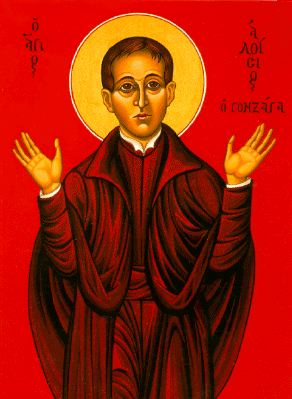
St. Aloysius was born in Castiglione, Italy. The first words St. Aloysius spoke were the Holy Names of Jesus and Mary. He was destined for the military by his father (who was in service to Philip II), but by the age of 9 Aloysius had decided on a religious life, and made a vow of perpetual virginity. To safeguard himself from possible temptation, he would keep his eyes persistently downcast in the presence of women. St. Charles Borromeo gave him his first Holy Communion. A kidney disease prevented St. Aloysius from a full social life for a while, so he spent his time in prayer and reading the lives of the saints. Although he was appointed a page in Spain, St. Aloysius kept up his many devotions and austerities, and was quite resolved to become a Jesuit. His family eventually moved back to Italy, where he taught catechism to the poor. When he was 18, he joined the Jesuits, after finally breaking down his father, who had refused his entrance into the order. He served in a hospital during the plague of 1587 in Milan, and died from it at the age of 23, after receiving the last rites from St. Robert Bellarmine. The last word he spoke was the Holy Name of Jesus. St. Robert wrote the Life of St. Aloysius. From: Catholic Online
It was revealed to him that he would pass on the Octave of Corpus Christi, and though he appeared much better in the days preceeding the Feast, Saint Aloysius Gonzaga did in fact turn and die on the Octave of Corpus Christi, June 21st, 1591.
Saint Aloysius Gonzaga is the Patron of Catholic youth. From:catholic-pages.com
Wednesday, June 21, 2006
Compendium to the Catechism of the Catholic Church
I received my copy yesterday. I recommend that everyone get a copy. It is in an easy to follow question and answer format that will be very beneficial for personal study and discussing the Catholic faith with others. As an added bonus the appendix contains many of the common prayers of the Church in both English and Latin.
Subscribe to:
Posts (Atom)